I catch the drop-off between onboarding and renewal, before it becomes churn.

Customer success and technical account manager with a DevOps and cloud engineering background. I onboard accounts to real usage, score health so a quiet one surfaces before it files a ticket, carry escalations through to a published postmortem, and start renewal reviews 90 days out.

3 years running a 30+ account wholesale book, 5 years in high-volume support, and the structured version runs on a platform I built and operate. I read the logs before I escalate, so engineering gets a reproduction and the customer gets an answer they can act on. See the engineering work

3 years running a real account book

Phinet Communication, 2017 to 2019. 30+ wholesale accounts alongside walk-in retail, roughly 10 worked directly. No CRM, so the signals were order frequency and who had gone quiet.

Onboarded first-time smartphone buyers to confidence in a week

Onboarding and time to value

A lot of our customers had never used a smartphone. Handing one over and wishing them luck meant they came back frustrated, or stopped using half of what they paid for.

So day 1 was setup and the basics: calls, texts, navigating the home screen. Most came back on day 2 for a deeper session on apps and features. The ones who did not come back were the ones I called, because somebody who gets stuck and feels foolish does not return on their own.

The target was full comfort inside a week, and the follow-up was the part that made it work.

Caught my largest account going quiet

Churn risk from a usage signal

My largest account ordered several times a week, with delivery to another state. Then her order frequency started dropping. No complaint, no argument, nothing filed. Just fewer orders.

I called her to ask why. A competitor was undercutting us on price. I went and checked that pricing myself rather than taking it at face value, confirmed it, and adjusted ours for her. Her volume came back to normal.

She was never going to raise a ticket. She was going to quietly buy somewhere else.

Turned one angry customer into a process fix

Escalation and recovery

A wholesale customer came into the shop angry. Phones he had bought from us kept showing a white-screen fault, a known factory problem, and repairs were going out of state and taking over a month. His own customers were leaving him over the wait.

Our CEO tried to calm him by explaining the fault was the manufacturer's, not ours. True, and useless to him, because his business was still losing customers.

I stepped in and made the point that this was not one angry man. Several accounts had raised the same delay. What we needed was a fix with the manufacturers, not another apology. The CEO took it further than I expected and got manufacturer representatives placed in our shop to push repairs through. Turnaround dropped from over a month to 1 to 2 weeks.

I read the logs before I escalate.

PulseOps is mine end to end: database schema, application, Terraform infrastructure on AWS, and a pipeline with no stored credentials. 29 automated tests run on every push.

In a 4-incident drill on a live server, Datadog caught each problem within 1 to 11 minutes and every one was fixed inside its SLA. While fixing one, I found the alert was watching the wrong disk.

The book I run on my own product

8 accounts managed in HubSpot for PulseOps, a product I built and run. Onboarding, health scoring, escalation, renewal planning and expansion, worked end to end.

The 8 customer companies are modelled. PulseOps is live, and the HubSpot records, health score outputs, incident timestamps and postmortems are real artifacts from working the book in it. Full write-ups and screenshots are in the case study.

  • A success target agreed at kickoff, proven on day 3

    Onboarding and time to value

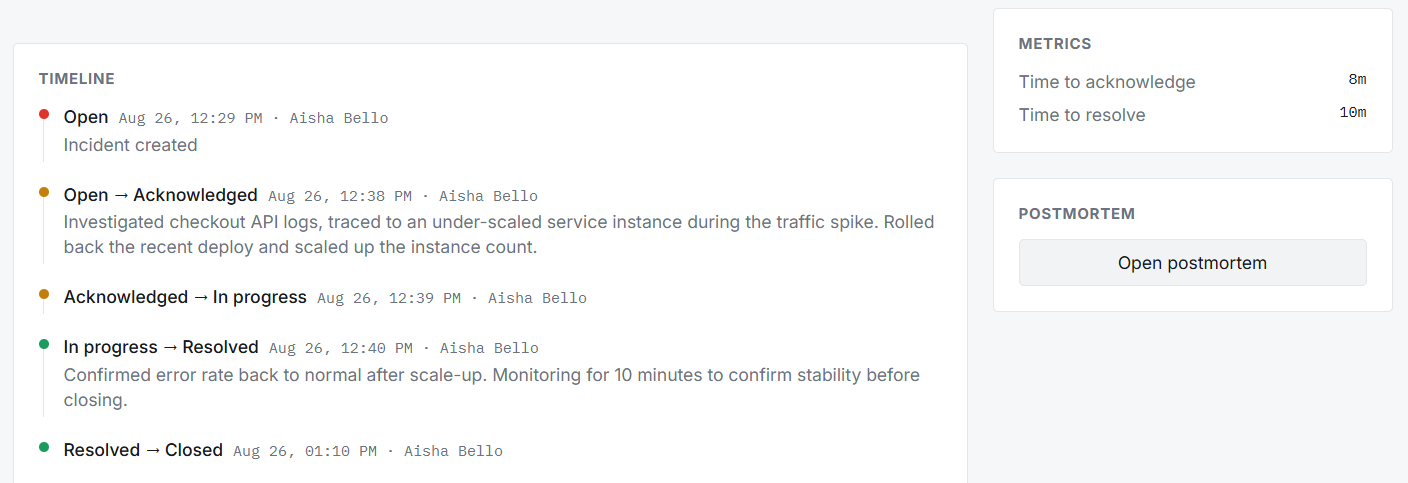
    Marlow Commerce agreed one measurable target with me at kickoff: acknowledge every incident in under 15 minutes. On day 3 their founding engineer declared a live incident to test it. Acknowledged in 8 minutes, resolved in 10, postmortem published the same day.

    PulseOps incident timeline acknowledged in 8 minutes and resolved in 10
    The incident timeline in PulseOps, with the platform's own timestamps.
  • Flagged the quiet account that never raised a ticket

    Health scoring and churn risk

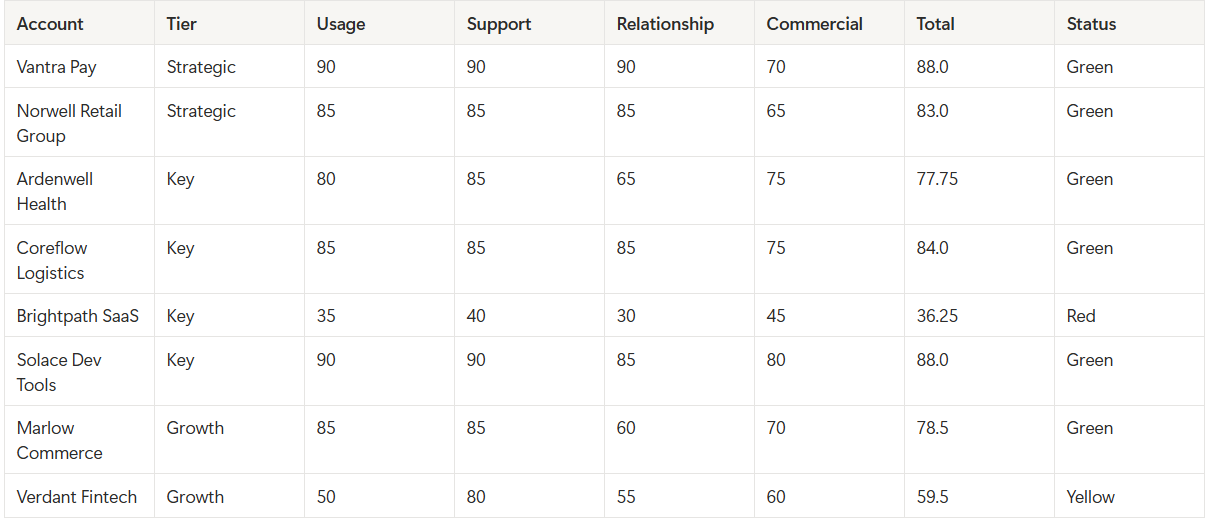
    I built a weighted health score, usage 45%, support 25%, relationship 20%, commercial 10%, and ran it across all 8 accounts. The hard catch was Verdant Fintech: no tickets, no incidents, and a Yellow score driven by low logins and one contact who had stopped replying.

    Sentiment is left out on purpose. There is no survey data, and a placeholder score would have been invented.

    Health score table for all 8 accounts
    The score applied to all 8 accounts, with its weights.
  • Kept a Red account at the table after our own outage

    Escalations and incident communication

    PulseOps ran with elevated errors for just over an hour while Brightpath SaaS's on-call team was mid-incident on their own systems and relying on it. I reached their engineering manager 15 minutes in and had root cause to her at the hour mark. The postmortem landed 3 days later, a day past the 48 hours I had promised.

    I asked for a call rather than leaving it at a document, and opened by saying it plainly: this happened when her team needed us most, and that is on us. Then a service credit and a working session with their whole on-call team. 3 of their engineers came, the first time anyone besides the manager had spoken to us.

    Usage has still not moved and the account is still Red at 36.25. The session built awareness. It has not rebuilt the habit.

  • A renewal review 90 days out, and the case for a plan upgrade

    Renewals, quarterly business reviews and expansion

    I ran Vantra Pay's quarterly business review 90 days before renewal, not the week before. Their COO asked for an auditor-friendly export of postmortems that the product does not have, so I logged it as product feedback and did not promise a date.

    Solace Dev Tools grew from 8 to 25 engineers and kept hitting its incident limit. I raised the upgrade during a clean, incident-free quarter so it landed as planning rather than a pitch, and their Head of Platform got it first for a technical read before it reached the CTO. The deal sits in HubSpot at $65,000.

What I work with

The practice behind the book.

  • Account management

    Book ownership from onboarding to renewal, executive and technical stakeholder relationships, quarterly business reviews, renewal planning at 90, 60 and 30 days.

  • Customer health and retention

    Weighted health scoring across usage, support, relationship and commercial signals, churn risk detection, save plans after escalation.

  • Expansion

    Spotting upsell from usage signals, building the business case, routing to the right stakeholder.

  • Escalation and incident communication

    Owning customer communication through an outage, service credits, postmortems, follow-through to resolution.

  • Technical troubleshooting

    Reading logs and telemetry to find root cause, replicating product issues, escalating with reproduction steps and context. AWS, Kubernetes, CI/CD.

  • Enablement and documentation

    Onboarding playbooks, runbooks, published postmortems, live training sessions, knowledge base upkeep.

  • Tools

    HubSpot CRM, Notion, Slack, Datadog, Intercom, Google Workspace, Git.

Where I have done this

Newest first.

  • Customer Success Portfolio

    PulseOps account book, HubSpot. Self-directed. August 2026 to present.

    Run the 8-account book above, from onboarding through health scoring, escalation and renewal planning to expansion, with a published postmortem for every incident.

  • DevOps Engineer and Dev Team Lead

    ScaleUpBuild - HelloAgain. Volunteer, remote. July 2026 to present.

    Lead the dev team on an AI-powered WhatsApp commerce platform, settling architecture trade-offs with leadership before anything is built.

  • Co-Trainer and DevOps Engineer

    Digital Witch Support Community. Part-time, remote. January 2025 to present.

    Teach live AWS and Azure sessions, and tune Datadog thresholds across 2 servers to cut false alarms while still catching a real traffic drop within 5 minutes.

  • Customer Support Representative

    Celebrity Fried Chicken, Abuja. January 2020 to December 2024.

    Won the company's Best Customer Support award and became the default trainer for every new hire, coaching them through 100+ in-person customers at peak alongside online orders.

    Tracked daily regulars and institutional accounts through loyalty-point activity and followed up when a week passed with no order. One lapsed regular turned out to be comparing our portions with a competitor's; I escalated it, the product team surveyed, portions changed, and she came back.

  • Key Accounts and Customer Relationship Manager

    Phinet Communication, Abakaliki. January 2017 to December 2019.

    Owned a book of 30+ wholesale accounts alongside walk-in retail, roughly 10 worked directly on their order patterns. Full write-up above.

  • Education and certifications

    Customer Success and Technical Account Management training, Digital Witch Support Community, in progress since August 2026.

    CKA (Certified Kubernetes Administrator), in progress.

    DevOps and Cloud Security Certification, Digital Witch Support Community, June 2026.

    BSc Cybersecurity, Miva Open University, Abuja.

    Technical Support Fundamentals, Google, November 2025.

Hiring a CSM or TAM?

Email is quickest. I work remotely from Abuja, Nigeria, on UTC+1.